Blue Gold: The Colonial Plant That Accidentally Dyed America's Uniform
The Color Worth More Than Silver
Every time you pull on a pair of jeans, you're wearing a piece of colonial American history. That distinctive blue isn't just any blue — it's indigo, a dye so valuable in the 1700s that South Carolina built its entire economy around it. But the story of how this "blue gold" became America's most common color is anything but common.
In 1739, sixteen-year-old Eliza Lucas received a handful of indigo seeds from her father in the Caribbean. What happened next would accidentally create the foundation for every pair of blue jeans ever made.
From Teenage Experiment to Economic Empire
Lucas wasn't trying to revolutionize American fashion — she was just trying to save her family's struggling plantation near Charleston. Her father, stationed in Antigua, had sent her several different seeds to experiment with, hoping she could find a profitable crop for their South Carolina land.
Indigo seemed like an odd choice. The plant produced a deep blue dye that was incredibly difficult to extract and process. But Lucas was persistent, and after three years of failed attempts, she finally cracked the code. By 1744, she had successfully produced the first commercially viable indigo dye in North America.
The timing couldn't have been better. Britain was in the middle of multiple trade wars, and their primary source of indigo — from French and Spanish colonies — had become unreliable and expensive. Suddenly, Lucas's blue dye wasn't just a curiosity; it was a strategic resource.
Why Indigo Chose Denim
When Levi Strauss and Jacob Davis were perfecting their riveted work pants in the 1870s, they faced a practical problem: what color should work clothes be? Brown showed every speck of dirt. Black was too formal and expensive to dye. But indigo offered something unique.
Unlike other dyes that penetrate deep into fabric fibers, indigo bonds only to the surface of cotton threads. This wasn't a flaw — it was a feature. The surface-level bonding meant that indigo-dyed fabric could withstand repeated washing and heavy use while gradually revealing the white cotton underneath. For workers who needed clothes that looked better with age rather than worse, indigo was perfect.
The dye's chemistry created what manufacturers now call "controlled fading." Each wash would strip away tiny amounts of blue, creating the worn-in look that made work pants appear broken-in rather than broken-down. It was accidental genius.
The Science Behind the Fade
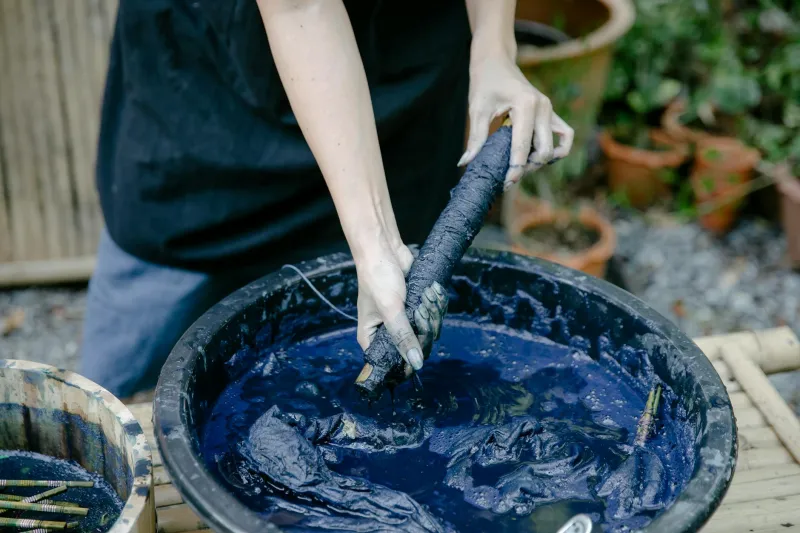
Indigo's unique behavior comes from its molecular structure. When indigo powder is mixed with water and a reducing agent (historically, fermented urine was used), it creates a yellow-green solution that appears to have no blue in it at all. Cotton fabric is dipped into this solution, then pulled out and exposed to oxygen. As the air hits the wet fabric, a chemical reaction occurs, and the blue literally appears before your eyes.
This oxidation process only affects the outer layer of each cotton fiber. The core remains white, which is why heavily worn jeans show white threads at stress points. Modern denim manufacturers have tried to replicate this effect with synthetic dyes, but none create the same gradual, natural-looking fade that indigo produces.
From Plantation to Factory Floor
By the 1790s, indigo had become South Carolina's second-largest export after rice, generating enormous wealth for plantation owners. But the industry was built on enslaved labor, and the knowledge of indigo processing was closely guarded within enslaved communities who had brought the techniques from West Africa.
When the Revolutionary War ended British subsidies for American indigo, the industry collapsed almost overnight. Synthetic indigo, developed in Germany in the 1890s, delivered the final blow to natural indigo farming in America. But by then, the color had already become permanently associated with American work clothes.
The Accidental Legacy
Today, Americans own an average of seven pairs of jeans, and nearly all of them are dyed with synthetic indigo that mimics the same surface-bonding process Eliza Lucas accidentally perfected in 1744. The global denim industry uses more indigo dye than any other single color, making it one of the most common synthetic chemicals in the world.
What started as a teenage girl's agricultural experiment became the signature color of American casual wear. Every faded knee, every worn pocket edge, every pair of jeans that looks better after a year of wear — it all traces back to a colonial-era accident that turned a difficult-to-grow plant into the most democratic color in fashion.
The next time you notice your jeans fading, remember: that's not wear and tear. That's 280 years of chemistry working exactly as designed, one wash at a time.