The Stale Batch That Built a Breakfast Empire
The Stale Batch That Built a Breakfast Empire
Most great American industries have a creation myth. Corn flakes have something better: a genuine accident, a health obsession that bordered on the bizarre, and a family rivalry that would make for a pretty decent HBO drama. The fact that you can walk into any gas station in the country and find a box of cereal is, in a roundabout way, the result of a batch of wheat that nobody threw away when they probably should have.
A Sanitarium, Not a Kitchen
To understand where breakfast cereal came from, you have to understand the Battle Creek Sanitarium in Michigan — and you have to understand that it was a deeply unusual place. Run by Dr. John Harvey Kellogg in the 1890s, the sanitarium operated somewhere between a medical facility and a wellness retreat, decades before "wellness retreat" was a phrase anyone used. Kellogg was a committed Seventh-day Adventist who believed that diet was the root of most human suffering. He was also, depending on your perspective, either a visionary or a zealot. Probably both.
Kellogg's dietary philosophy was built around one core conviction: bland food was morally and physically superior to flavorful food. He thought spices and meat stimulated the body in ways that led to all kinds of problems. His patients — many of them wealthy Americans seeking cures for digestive ailments — were fed a strict regimen of grains, nuts, and vegetables. Flavorless, by design.
In 1894, Kellogg and his brother Will Keith Kellogg were working in the sanitarium kitchen, experimenting with wheat-based foods they could serve to patients. They boiled a batch of wheat, then got pulled away — the accounts vary on exactly how long it sat — and came back to find it had gone stale. Rather than waste it, they decided to run it through the rollers they used to make dough sheets. Instead of a flat sheet, each individual grain of wheat puffed out into its own thin flake. When they baked those flakes, the result was a light, crispy food that patients actually seemed to enjoy eating. That was basically a miracle by Battle Creek Sanitarium standards.
The Brothers Split
For a while, the Kellogg brothers were working toward the same goal: a healthy, grain-based food that could support their patients' recovery. But they had very different ideas about what to do with what they'd stumbled onto.
John Harvey saw the flakes as medicine. A tool for healing. He had no interest in commercializing them beyond the sanitarium's walls — and he was especially opposed to adding sugar, which he considered close to poison.
Will Keith saw something else entirely. He saw a product. He saw a market. He saw the millions of Americans who weren't living in a Michigan sanitarium but who might still want something quick and easy to eat in the morning. In 1906, Will broke from his brother and founded the Battle Creek Toasted Corn Flake Company — note the pivot from wheat to corn, partly for taste, partly to distinguish himself. He also did something John Harvey never would have allowed: he added a small amount of sugar to the recipe.
That decision quietly changed everything.
From Health Food to Habit
Will Keith Kellogg turned out to be a natural marketer in an era when mass marketing was still figuring out what it was. He bought a full page in Ladies' Home Journal in 1906, one of the largest magazine ads of its time. He offered free samples by mail. He put a prize — a Kellogg's Funny Jungleland Moving Pictures book — inside boxes, essentially inventing the cereal box prize decades before anyone thought to call it that.
By 1909, the company was producing nearly a million boxes a week.
Other entrepreneurs noticed. Battle Creek became a kind of cereal gold rush town, with dozens of competitors launching their own grain-based breakfast products. C.W. Post, who had actually been a patient at the sanitarium, launched his own competing brand. The city that had been home to a single eccentric health retreat became the cereal capital of the world, a title it still technically holds.
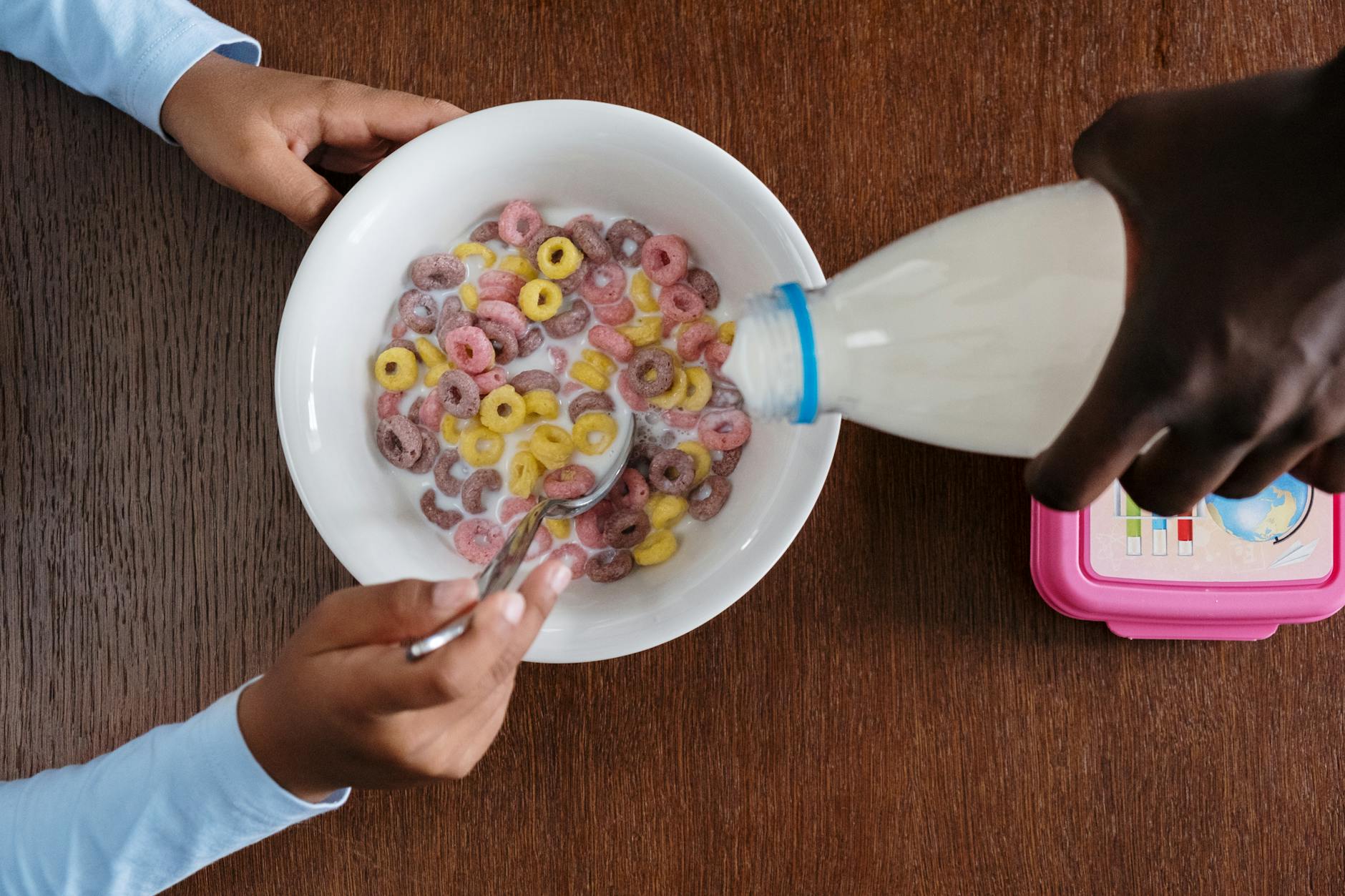
And then the industry kept evolving — away from the health-obsessed roots and toward something John Harvey Kellogg would have considered catastrophic. By the mid-20th century, cereals were being engineered specifically for children, loaded with sugar, and marketed through Saturday morning cartoons. Froot Loops, Cap'n Crunch, Lucky Charms — none of these have any meaningful connection to the digestive-health philosophy that produced the original flake. They are, in a sense, the exact opposite of what the whole thing was supposed to be.
The Irony at the Bottom of the Bowl
There's something genuinely funny about the distance between the origin and the outcome here. A man who thought sugar was ruining American health accidentally set off a chain of events that produced some of the most sugar-dense foods in the American diet. A product invented to be as bland and medically purposeful as possible became the vehicle for cartoon toucans and marshmallow shapes.
And yet the basic format — grain, milk, bowl, morning — stuck. Americans eat billions of bowls of cereal every year. The ritual of breakfast cereal is so deeply embedded in daily life that it barely registers as a choice anymore. It's just what mornings look like.
All of it traces back to a batch of wheat that sat out too long in a Michigan kitchen, and two brothers who couldn't agree on what to do with it. One wanted to heal people. One wanted to feed them. The one who added sugar won — and breakfast has never quite recovered.