The Tree-Saver That Backfired
Sten Gustaf Thulin had the best intentions when he sat down at his drawing board in 1959. The Swedish engineer working for packaging company Celloplast was tasked with creating a better shopping bag—one that would be stronger than paper, reusable like cloth, and cheap enough for mass production. His solution seemed brilliant: a simple plastic bag with handles, made from polyethylene that could be folded flat and used again and again.
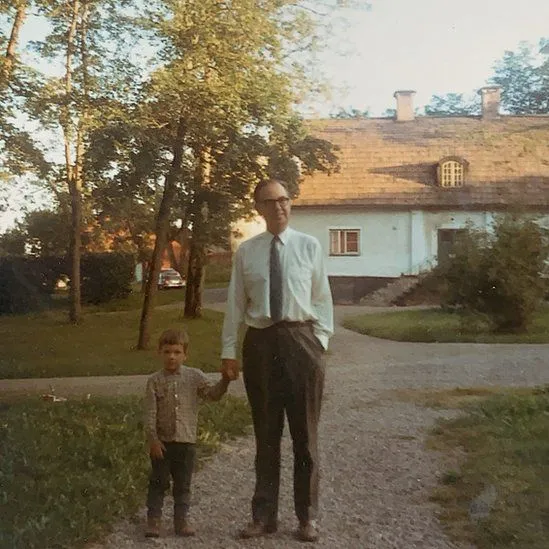 Photo: Sten Gustaf Thulin, via ichef.bbci.co.uk
Thulin's design was elegant in its simplicity. Two pieces of tubular polyethylene film, heat-sealed at the bottom and sides, with handles punched out of the top. No glue, no stitching, no complicated manufacturing process. He called it the "T-shirt bag" because of its distinctive shape, and he genuinely believed he was creating an environmental solution.
The cruel irony is that Thulin was right about almost everything—except human nature.
From Radar Screens to Shopping Carts
The plastic that made Thulin's bags possible had its own unlikely origin story. Polyethylene was first created by accident in 1933 by British chemists who were trying to make something else entirely. But it wasn't until World War II that the material found its calling as insulation for radar cables, giving Allied forces a crucial technological advantage.
After the war, chemical companies found themselves with massive polyethylene production capabilities and no military contracts to fulfill. Like so many wartime technologies, plastic needed to find civilian applications. It showed up in Tupperware, squeeze bottles, and eventually, shopping bags.
When American supermarket chains discovered Thulin's design in the early 1960s, they saw dollar signs. Paper bags required storage space, tore easily, and couldn't handle wet items. Plastic bags were waterproof, incredibly strong for their weight, and could be stored in compact dispensers. By 1979, Safeway and Kroger had begun switching to plastic bags nationwide.
The Convenience Revolution
American retailers marketed plastic bags as a premium upgrade. They were presented as more sanitary than paper, easier to carry, and better for the environment because they didn't require cutting down trees. Grocery stores initially charged extra for them, positioning plastic bags as a luxury convenience item.
The strategy worked perfectly. American shoppers embraced plastic bags with enthusiasm, appreciating their strength and waterproof qualities. Unlike paper bags that split when overloaded or dissolved in rain, plastic bags seemed indestructible. Shoppers began keeping them for secondary uses—lining trash cans, storing wet swimsuits, picking up after dogs.
What nobody calculated was the scale. Americans were soon using billions of plastic bags annually, and most were being used exactly once before disposal. Thulin's reusable design had become the ultimate single-use item.
The Mathematics of Disaster
By the 1990s, the numbers were staggering. Americans were consuming roughly 100 billion plastic bags per year—that's about 300 bags for every person in the country, including newborn babies. The bags that were supposed to last for years were lasting for centuries in landfills and oceans instead.
The very qualities that made plastic bags perfect for shopping made them environmental disasters. They were so lightweight they became airborne litter, so durable they never decomposed, and so ubiquitous they infiltrated every ecosystem on Earth. Marine biologists began finding plastic bags in the stomachs of sea turtles, whales, and seabirds thousands of miles from the nearest shopping center.
The "tree-saving" invention was creating problems that made paper bag production look environmentally trivial by comparison. Paper bags, for all their flaws, decomposed within months. Plastic bags would outlive their users by several centuries.
The Backlash and the Legacy
By 2007, San Francisco became the first American city to ban plastic bags, launching a movement that would eventually reach hundreds of municipalities. Environmental groups that had once praised plastic bags as forest-friendly began calling them one of the worst inventions of the 20th century.
 Photo: San Francisco, via 4kwallpapers.com
Thulin, who died in 2006, reportedly expressed regret about his invention's environmental impact in his later years. He had designed the bags to be reused 40-50 times, making them genuinely more sustainable than paper alternatives. The problem wasn't his engineering—it was the throwaway culture that American consumer society had wrapped around his design.
From Solution to Symbol
Today, the plastic shopping bag serves as a perfect symbol of unintended consequences. It represents how good intentions, brilliant engineering, and market forces can combine to create problems nobody anticipated. The bag that was supposed to save trees became the poster child for plastic pollution.
Modern alternatives—paper bags, reusable cloth bags, biodegradable plastics—all trace their market existence back to the problems created by Thulin's original solution. Even the "paper or plastic?" question that defined American grocery shopping for decades was really asking customers to choose between two environmental compromises.
The story of the plastic bag reveals something fundamental about innovation in consumer culture. The most successful inventions aren't necessarily the ones that work as intended—they're the ones that adapt to how people actually behave, regardless of the consequences. Thulin created a bag designed for responsibility, but American consumer culture transformed it into an icon of disposability.
In the end, perhaps the plastic bag's greatest legacy isn't environmental—it's educational. It taught an entire generation that convenience and sustainability don't automatically go hand in hand, and that the most dangerous inventions are often the ones with the best intentions.