That Tiny Pocket in Your Jeans Has a Secret Life — And It's Older Than You Think
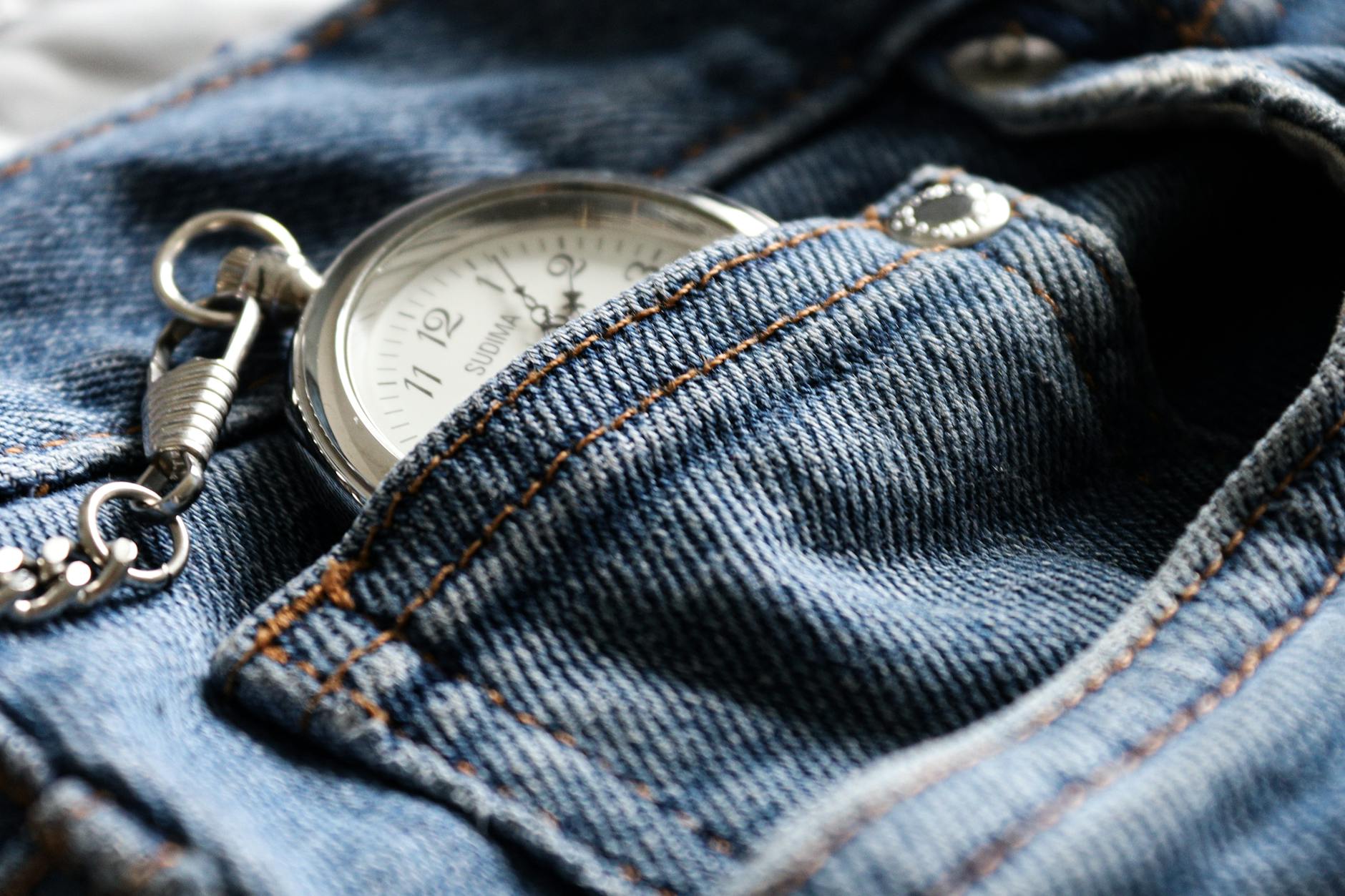
That Tiny Pocket in Your Jeans Has a Secret Life — And It's Older Than You Think
At some point, usually while standing in a parking lot or waiting in a line, you've probably stuck your thumb into that odd little pocket tucked inside the right front pocket of your jeans and thought: what is this even for? It's too shallow for your phone. A credit card slides right out. A lip balm might survive in there if conditions are perfect and you don't move too quickly.
And yet there it is, sewn faithfully into virtually every pair of jeans on the market, year after year, decade after decade — a tiny fabric mystery that the fashion industry keeps reproducing without much explanation.
Here's the thing: it actually has a name, a history, and a very specific original purpose. It's just that the purpose vanished about a hundred years ago, and nobody ever got around to removing the pocket.
Meet the Watch Fob Pocket
Go back to the American West in the late 19th century. Cowboys, ranchers, and working men across the frontier carried pocket watches — the dominant personal timekeeping technology of the era. A good pocket watch was valuable, both financially and practically, and it needed protection from the dust, jolts, and general chaos of daily frontier life.
When Levi Strauss & Company introduced their riveted work pants in 1873, they included a small, reinforced pocket specifically designed to hold a pocket watch securely. It sat just inside the right front pocket, snug enough to prevent the watch from bouncing around, and it became a standard feature of the design almost immediately. In the trade, it was called a watch fob pocket — a fob being the short chain or strap attached to a pocket watch that made it easy to pull out quickly.
For working men who depended on knowing the time — for catching trains, managing livestock, coordinating labor — this little pocket was genuinely useful. It wasn't decorative. It wasn't a quirk. It was engineering.
The Watch Disappeared. The Pocket Didn't.
By the early 20th century, the wristwatch was steadily replacing the pocket watch as the everyday timekeeping device of choice. World War I accelerated the shift dramatically — soldiers in the trenches couldn't exactly fish a pocket watch out of their pants under fire, and the wristwatch proved far more practical in combat. By the 1920s, pocket watches were already beginning to feel old-fashioned.
And yet the little pocket stayed. Nobody made an official decision to keep it. Nobody wrote a memo defending its continued existence. It was simply already there, already part of the pattern, already part of what a pair of Levi's looked like — and changing it would have required someone to actively notice it and actively decide to remove it. Fashion, it turns out, has enormous inertia. Things persist not because they're still useful but because nobody stopped to ask whether they should.
The watch fob pocket became vestigial — the appendix of denim design. It was there, it wasn't hurting anything, and over time it became so associated with the look of jeans that removing it might have actually felt wrong to consumers, even if they couldn't explain why.
A Window Into How Fashion Actually Works
There's something genuinely funny about the fact that millions of Americans are walking around today with a pocket designed for a technology that most people under 50 have never carried. But the watch fob pocket is also a surprisingly honest illustration of how fashion evolves — or more accurately, how it often doesn't evolve, even when the original logic has long since evaporated.
Fashion is full of these ghost details. The buttons on the sleeves of men's suit jackets? Originally designed so that soldiers could roll up their sleeves without removing their coats. The small loop on the back of Oxford shirts? It was added so that Ivy League students in the 1960s could hang their shirts on locker hooks without wrinkling them. The little plastic aglets on shoelace tips? Medieval in origin, designed to make threading laces through eyelets easier before mass-produced laces existed.
None of these features are strictly necessary anymore. But they persist because they became part of what those garments look like, and altering them would feel like breaking something even if you couldn't quite articulate what.
So What Do People Actually Use It For?
In the absence of a pocket watch, the watch fob pocket has developed a kind of informal second life. People use it for coins, guitar picks, folded cash, a single earbud, a USB drive, a spare key, a stick of gum, a ring they don't want to lose. Reddit threads dedicated to the question of what people actually put in there run surprisingly long.
Some people — and this is perhaps the most endearing possible outcome — don't use it for anything at all. They just know it's there. A small, pointless, historically loaded rectangle of denim that has survived the pocket watch, two world wars, the digital revolution, and the entire arc of American casual fashion without ever being asked to justify its existence.
Next time you pull on a pair of jeans, give it a thought. That little pocket isn't useless. It's a time capsule — which is, come to think of it, exactly what it was always designed to carry.