The Chemistry Lab Spill That Revolutionized American Kitchens
The Day Everything Went Wrong in Roy Plunkett's Lab
April 6, 1938, started like any other day at DuPont's Jackson Laboratory in New Jersey. Roy Plunkett, a 27-year-old chemist, was deep into his latest project: creating a new type of refrigerant gas. He had been working with tetrafluoroethylene, a colorless gas that showed promise for keeping things cold.
 Photo: DuPont's Jackson Laboratory, via avos.kitchen
But when Plunkett opened his pressurized cylinder that morning, nothing came out. The gas had mysteriously vanished overnight. Most scientists would have cursed their luck, tossed the cylinder, and started over. Plunkett did something different—he got curious.
When Failure Becomes Discovery
Instead of discarding what appeared to be a failed experiment, Plunkett decided to saw open the cylinder. Inside, he found something completely unexpected: a white, waxy powder that felt slippery to the touch. The gas hadn't disappeared—it had spontaneously polymerized into something entirely new.
This accidental substance had remarkable properties. It was virtually inert, meaning it wouldn't react with other chemicals. It could withstand extreme temperatures. And most importantly, nothing seemed to stick to it. Plunkett had accidentally created polytetrafluoroethylene—later trademarked as Teflon.
DuPont immediately recognized they had something valuable, but they had no idea what to do with it. For nearly two decades, Teflon remained primarily a military and industrial material, used in everything from atomic bomb production to spacecraft components.
The French Connection That Changed Everything
The kitchen revolution began not in America, but in France. In 1954, French engineer Marc Grégoire was using Teflon to prevent his fishing tackle from tangling. His wife, Colette, had a brilliant suggestion: if this stuff kept fishing line from sticking, why not try it on cooking pans?
 Photo: Marc Grégoire, via c8.alamy.com
Grégoire experimented with bonding Teflon to aluminum cookware, creating the first non-stick frying pan. He called it "Tefal"—a combination of "Teflon" and "aluminum." French housewives embraced it immediately.
American manufacturers initially dismissed the idea. The process was expensive, the coating seemed fragile, and frankly, American cooks had been getting along just fine with cast iron and steel for generations.
America Finally Gets with the Program
The turning point came in the early 1960s when Marion A. Trozzolo, an American entrepreneur, saw Tefal pans at a French housewares show. He recognized the potential and licensed the technology, launching "The Happy Pan" in 1961—America's first mass-marketed non-stick cookware.
The timing was perfect. Post-war America was experiencing a boom in convenience culture. TV dinners, cake mixes, and frozen foods were reshaping how families ate. Non-stick pans fit perfectly into this narrative of modern, effortless cooking.
The Kitchen Chemistry Revolution
By the 1970s, non-stick cookware had fundamentally changed American cooking habits. Suddenly, you could cook eggs without butter, sauté vegetables with minimal oil, and clean up with just a gentle wipe. Home cooks became amateur chemists, learning about heat distribution, surface tension, and the delicate balance needed to preserve their non-stick coatings.
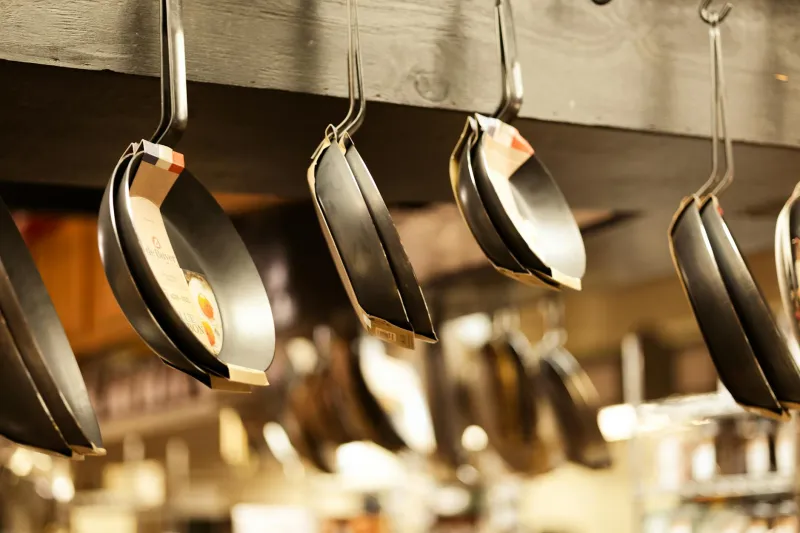
The technology spawned an entire industry. T-fal, Calphalon, and dozens of other brands competed to create better, more durable non-stick surfaces. Infomercials promised pans so slippery that cheese wouldn't stick. Kitchen stores dedicated entire aisles to the growing array of non-stick options.
The Dark Side of the Miracle Coating
But Plunkett's accidental discovery carried a hidden cost. By the 1990s, scientists began discovering that the chemicals used to manufacture Teflon—particularly PFOA (perfluorooctanoic acid)—were accumulating in the environment and human bloodstream.
The very properties that made Teflon so useful—its resistance to breaking down—meant it persisted in nature indefinitely. Studies linked PFOA exposure to various health problems, from liver damage to cancer. DuPont faced massive lawsuits and eventually agreed to phase out PFOA production.
The Legacy of a Laboratory Accident
Today's non-stick cookware uses different formulations, but the basic principle remains unchanged: Plunkett's accidental discovery still coats millions of American frying pans. The chemistry lab spill that happened on a random Tuesday in 1938 continues to influence how we cook, what we eat, and even how we think about the trade-offs between convenience and safety.
Every time you slide a perfect omelet from your non-stick pan, you're benefiting from one of history's most consequential accidents—a reminder that sometimes the most transformative discoveries happen when experiments go completely wrong.