Why You Stick Out Your Hand When You Meet Someone New
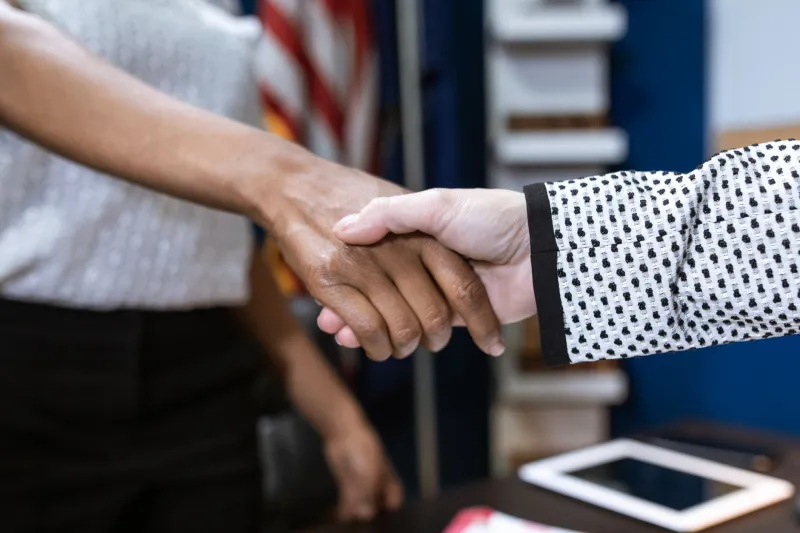
You do it without thinking. Someone walks into a room, extends their hand, and your arm shoots out before your brain has even processed what's happening. The handshake is so deeply embedded in American social life that skipping it feels almost rude — like you're hiding something. Which, funnily enough, is exactly what the gesture was originally designed to prevent.
The Oldest Reason to Show Your Hand
The story of the handshake goes back further than most people expect. Ancient Greek artwork — some of it dating to the 5th century BCE — shows figures clasping hands in what looks unmistakably like a modern handshake. Homer references it in both the Iliad and the Odyssey as a gesture of pledging. Roman reliefs depict emperors and soldiers locking right hands to seal alliances and mark the end of conflicts.
The working theory, and it's a good one, is straightforward: extending your right hand — historically the hand you'd use to hold a weapon — was a way of showing you weren't holding one. It was transparency made physical. You're essentially saying, I'm coming to you open-handed, literally. In a world where strangers were a genuine threat and trust had to be established fast, this was a remarkably efficient communication tool.
But here's what's interesting. For most of ancient and medieval history, the handshake wasn't the universal greeting it is today. Bowing, kneeling, cheek-kissing, hat-tipping — these were all equally common, and which one you used depended heavily on your social class, your region, and who you were greeting. The handshake had competition.
The Quakers Changed Everything
One of the most underappreciated chapters in handshake history involves the Religious Society of Friends — better known as the Quakers — who became unlikely architects of the modern greeting culture in 17th-century England and colonial America.
Quaker theology held that all people were equal before God. That meant the elaborate bowing and hat-doffing that marked social hierarchy were, to them, spiritually problematic. You didn't bow to a king if you believed no man stood higher than another in God's eyes. Instead, Quakers adopted the handshake as their preferred greeting precisely because it was level. Two people met palm to palm, neither elevated above the other.
As Quaker communities grew in colonial Pennsylvania and beyond, their customs spread. William Penn's settlement in particular became a commercial hub, and the Quaker practice of greeting business partners with a handshake rather than a bow carried a quiet egalitarian message that resonated in a society actively building itself away from European class structures. The handshake fit the American project almost perfectly.
When Business Made It Official
By the 18th and 19th centuries, the handshake had a firm foothold in commercial life. Trade agreements, property deals, and partnerships were routinely sealed with a clasp — which is where phrases like "sealing the deal" and "a firm handshake" got their staying power. The grip itself carried meaning: too limp suggested weakness or evasiveness, too crushing suggested aggression. There was an entire unspoken language encoded in a three-second gesture.
The Industrial Revolution accelerated things further. As Americans moved from agricultural communities — where everyone already knew each other — into cities and factories full of strangers, there was suddenly a massive social need for a quick, reliable trust signal. The handshake answered that need. It was fast, it was neutral, it required no props, and it worked across class lines in a way that bowing simply didn't.
By the time Emily Post published her landmark etiquette guide in 1922, the handshake was so entrenched in American professional life that she dedicated significant space to its proper execution. At that point, it wasn't a custom anymore. It was a rule.
The Moment It Almost Got Replaced
The handshake's dominance has been challenged a few times, most recently and dramatically during the COVID-19 pandemic, when public health guidance essentially banned it overnight. Suddenly, Americans were fist-bumping, elbow-tapping, nodding, and waving — and some workplace culture commentators declared the handshake finished.
It wasn't. Within a year or two of restrictions lifting, the handshake came roaring back, which tells you something important about how deeply this gesture is wired into our social instincts. Alternatives felt provisional, slightly awkward, like a workaround rather than a real greeting. The handshake, for all its ordinariness, carries a weight that substitutes just can't replicate.
A Gesture That Keeps Earning Its Place
What's remarkable about the handshake is that it has survived for over two thousand years not because it was mandated or marketed, but because it kept solving the same fundamental human problem: how do you signal good faith to a stranger, fast?
The ancient Greek soldier and the modern job applicant are doing the same thing — extending an open hand, making themselves briefly vulnerable, and betting that the person across from them will do the same. That exchange, however brief and businesslike it looks, is actually a pretty profound act of trust.
Next time someone puts their hand out, it's worth remembering: you're participating in one of the longest-running social contracts in human history. You just happen to be doing it in a conference room in Cleveland.