Why Everything Around You Is Color-Coded — And How One Frantic Hospital Started It All
Think about the last hour of your day. You stopped at a red light. You checked a weather app where orange meant something worse than yellow. You sorted recycling into a blue bin. You watched a cable news graphic divide the country into red and blue states. You may have grabbed a color-coded file folder, followed a colored line on a transit map, or glanced at a chart where the bars were different colors so you'd know which was which.
Color is the invisible grammar of modern American life. We use it to organize, warn, guide, categorize, and rank almost everything. It feels completely natural — almost like it couldn't have been any other way. But before the twentieth century, almost none of this existed. The systematic use of color as a universal organizational signal is surprisingly recent, and its origin story runs straight through a problem that had nothing to do with design.
The Ward That Couldn't Move Fast Enough
In the early 1900s, American hospitals were growing faster than anyone had anticipated. Urbanization was packing cities with workers, immigrants, and industrial accident victims, and the large municipal hospitals built to serve them were becoming genuinely chaotic places. Corridors were crowded. Admissions were backlogged. Staff rotated constantly through unfamiliar wings. Paper intake forms piled up faster than anyone could process them.
The specific pressure point was routing — getting the right patient to the right ward quickly, without requiring every orderly and volunteer to have memorized the building's layout. Written signs helped, but reading takes a moment, and in a crowded hallway, a moment is what you don't have.
Some hospitals began experimenting with a simple fix: paint the floor, or the wall stripe near the floor, in different colors for different departments. Follow the red line to surgery. Follow the blue line to maternity. No reading required. The instruction was embedded in the environment itself.
It worked immediately. The idea spread between hospital administrators the way practical fixes always do — through word of mouth, professional conferences, and the simple logic that it solved a real problem without requiring any new equipment or training.
The Idea Escapes the Building
Once the concept existed — that color could carry routing information without language — it was only a matter of time before other crowded, fast-moving institutions noticed. The subway systems expanding beneath American cities in the 1910s and 1920s faced almost identical problems. Underground stations all looked alike. Passengers unfamiliar with a system could easily board the wrong train. Printed maps were consulted, but slowly.
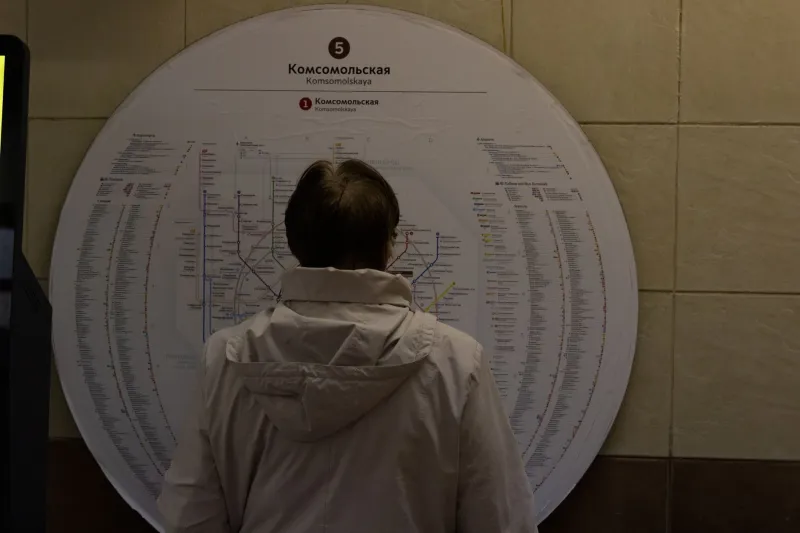
The colored line — already proven in hospitals — was an obvious solution. New York's subway map formalized distinct colors for distinct lines. Boston followed. Chicago followed. By mid-century, the color-coded transit map was a standard piece of American urban infrastructure, and the logic underneath it was the same logic a harried hospital administrator had improvised to move patients faster.
 Photo: New York, via images.fineartamerica.com
The highway system extended it further. The Federal Aid Highway Act of 1956, which funded the Interstate system, also standardized signage. Green for directional guidance. Blue for services. Brown for recreation. Red for prohibitions. The color assignments weren't arbitrary — they drew on decades of accumulated convention, much of it rooted in the same practical instincts that had colored hospital corridors. The goal was always the same: communicate faster than language allows.
When Color Became Identity
The organizational leap from routing to identity is where things get culturally interesting. Sports teams had used color for decades as a simple way to distinguish one side from another on a field — but by the mid-twentieth century, team colors had become something much deeper. They were brand identities, tribal affiliations, emotional anchors. The green of the Celtics or the blue of the Cowboys wasn't just a practical differentiator anymore. It was a feeling.
Advertising accelerated this. Once marketing research confirmed that color reliably triggered consistent emotional responses — red for urgency, blue for trust, yellow for attention — brands began treating color as a strategic asset rather than a decorative choice. The red of a Coca-Cola can. The brown of a UPS truck. The orange of a Home Depot apron. Each of those choices was deliberate, and each of them worked because Americans had been trained, over decades, to process color signals quickly and emotionally.
The political color map arrived relatively late. Red for Republicans and blue for Democrats only became consistent during the 2000 presidential election, when TV networks needed a standardized way to display electoral results in real time. Before that, the assignments had flipped from network to network and election to election. The current map is, in historical terms, barely old enough to drive — yet it already feels permanent, like it was always true.
The Grammar You Never Learned
What's striking about the color-coding of American life is how completely invisible the system has become. Nobody teaches you that red means danger or that green means permitted. Nobody explains the subway map's logic before you use it. You absorb the grammar passively, through repetition, and eventually it stops seeming like a system at all. It just seems like the way things are.
That invisibility is the system's greatest success. The hospital administrator who painted a floor stripe to move patients faster wasn't trying to redesign American visual culture. They were trying to survive a Tuesday. But the logic they reached for — simple, fast, language-free — turned out to be so useful that it quietly colonized almost every organizing system the country built afterward.
The next time you follow a colored line on a map, or glance at a red notification badge on your phone, or watch an election map fill in with familiar colors — you're running the same basic software. It was written in a hospital hallway, probably sometime around 1910, by someone who just needed people to stop getting lost.