The Lonely Lighthouse and the Hobby That Hooked 45 Million Americans
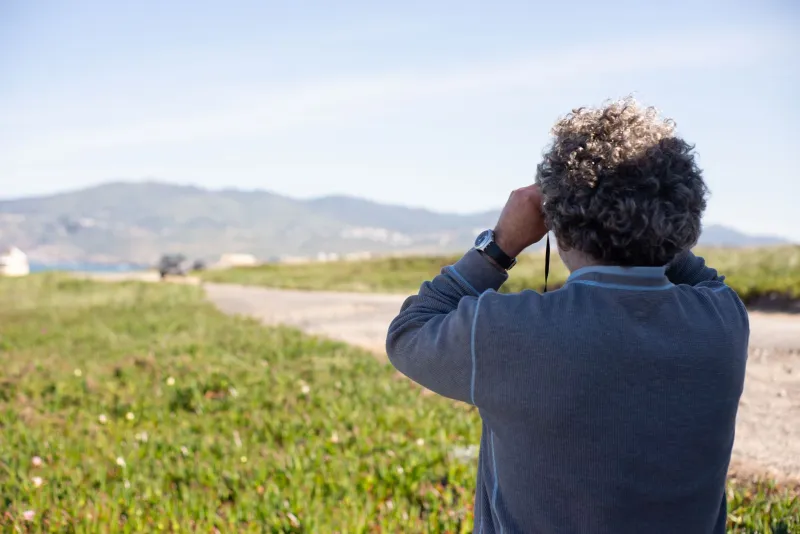
You probably know someone who owns a pair of binoculars they never use for sports. Maybe you've driven past a state park trailhead and noticed a cluster of people standing very still, all pointing at the same tree. Birdwatching is so woven into American recreational life that it barely registers as unusual anymore. But the path that got us here runs through lighthouse isolation, a Victorian publishing revolution, and a wartime accident that handed ordinary Americans the one tool the hobby had always been missing.
The Man With Nothing to Do But Watch
In the mid-1800s, lighthouse keeping was considered one of the lonelier postings the federal government could assign a person. You lived on a rock, or a barrier island, or a fog-soaked headland, and your job was to make sure a light stayed burning. The work itself took maybe two hours a day. The rest was silence.
Keepers who lasted in those postings long-term tended to develop elaborate private systems for filling time. Some built furniture. Some wrote letters that never got sent. And a surprising number of them started keeping detailed records of the birds that passed by their lights — especially at night, when migratory species would circle the beam in enormous, disorienting flocks.
These weren't scientists. They were bored people with notebooks. But their records turned out to be extraordinarily precise, and when early ornithologists began cross-referencing lighthouse logs from Maine to Florida, they discovered a coherent, continent-wide picture of bird migration that no single researcher could have assembled alone. The lighthouse keepers had accidentally built America's first citizen science network.
The Book That Made It a Pastime
The formal turn toward birdwatching as something ordinary people might do on purpose — rather than just observe incidentally — owes a lot to one publication. In 1889, Florence Merriam Bailey published Birds Through an Opera Glass, a field guide written not for academic ornithologists but for curious general readers. It was the first American bird book that assumed its audience had no scientific training and simply wanted to know what they were looking at.
 Photo: Florence Merriam Bailey, via s.inyourpocket.com
The timing was sharp. The late Victorian period was experiencing a broad cultural shift toward organized outdoor leisure — hiking clubs, naturalist societies, botanical illustration as a hobby. Bailey's book landed in that current and rode it hard. Within a decade, the Audubon Society had reorganized itself as a national movement, bird identification walks were appearing in city parks, and the idea of going outside specifically to look at birds had acquired a name and a social infrastructure.
 Photo: Audubon Society, via theworldtravelindex.com
Still, something was missing. Watching birds with the naked eye or through opera glasses — the delicate theater accessories Bailey's title referenced — was a frustrating experience. Birds move fast, perch high, and disappear the moment you've almost identified them. The hobby had a fundamental equipment problem.
The War That Handed Everyone a Telescope
The solution arrived from an entirely unrelated direction. During World War II, the US military manufactured binoculars at a scale that had never been attempted before. Hundreds of thousands of units were produced for naval spotters, artillery observers, and infantry scouts. The optics industry essentially grew up overnight under contract pressure.
When the war ended, that production capacity didn't just switch off. Surplus military binoculars flooded the civilian market at prices ordinary families could actually afford. For the first time, a reliable, high-magnification optical instrument wasn't a luxury purchase — it was a garage sale find, a mail-order catalog item, a thing you might receive as a birthday gift.
Bird populations hadn't changed. The birds were exactly where they'd always been. But suddenly, millions of Americans had the hardware to actually see them properly, and they discovered — apparently to their own surprise — that birds were genuinely interesting to look at.
Roger Tory Peterson and the Democratization of Knowing What You're Seeing
The final piece of the puzzle was a field guide that worked the way a real person's brain works. Roger Tory Peterson's A Field Guide to the Birds, first published in 1934 but updated and widely distributed through the postwar decades, organized identification around visual patterns rather than scientific taxonomy. Peterson used arrows on illustrations to point directly at the specific markings that distinguished one species from another — the field marks, he called them. You didn't need to know Latin. You needed to know what to look for.
Peterson's system paired perfectly with affordable postwar binoculars. You spotted something, you lifted your glasses, you found the relevant page. The loop closed in under a minute. The learning curve that had kept birdwatching semi-exclusive suddenly flattened.
Forty-Five Million People and a Billion-Dollar Industry
The US Fish and Wildlife Service currently estimates that roughly 45 million Americans consider themselves birdwatchers or wildlife observers. That's a number that rivals bowling, golf, and recreational fishing as a participation sport. The gear market alone — binoculars, spotting scopes, specialty clothing, feeders, seed, apps — generates billions annually. The Cornell Lab of Ornithology's eBird platform, which lets birders log and share sightings in real time, has accumulated more than a billion individual bird observations contributed by regular people.
None of that was planned. It grew from a lighthouse keeper's notebook, a woman who thought opera glasses weren't quite good enough, a wartime manufacturing surplus, and a man who figured out how to draw an arrow at the right spot on a picture of a warbler.
The next time you see someone standing very still at a trailhead, pointing at a tree, remember: they're the latest link in a chain that started with someone trying to stay sane on a rock in the middle of the ocean. The birds were always there. It just took about a century of accidents to teach us how to actually look at them.