The Layout That Refused to Die: How a Typing Contest and a Telegram Changed the Way You Type Forever
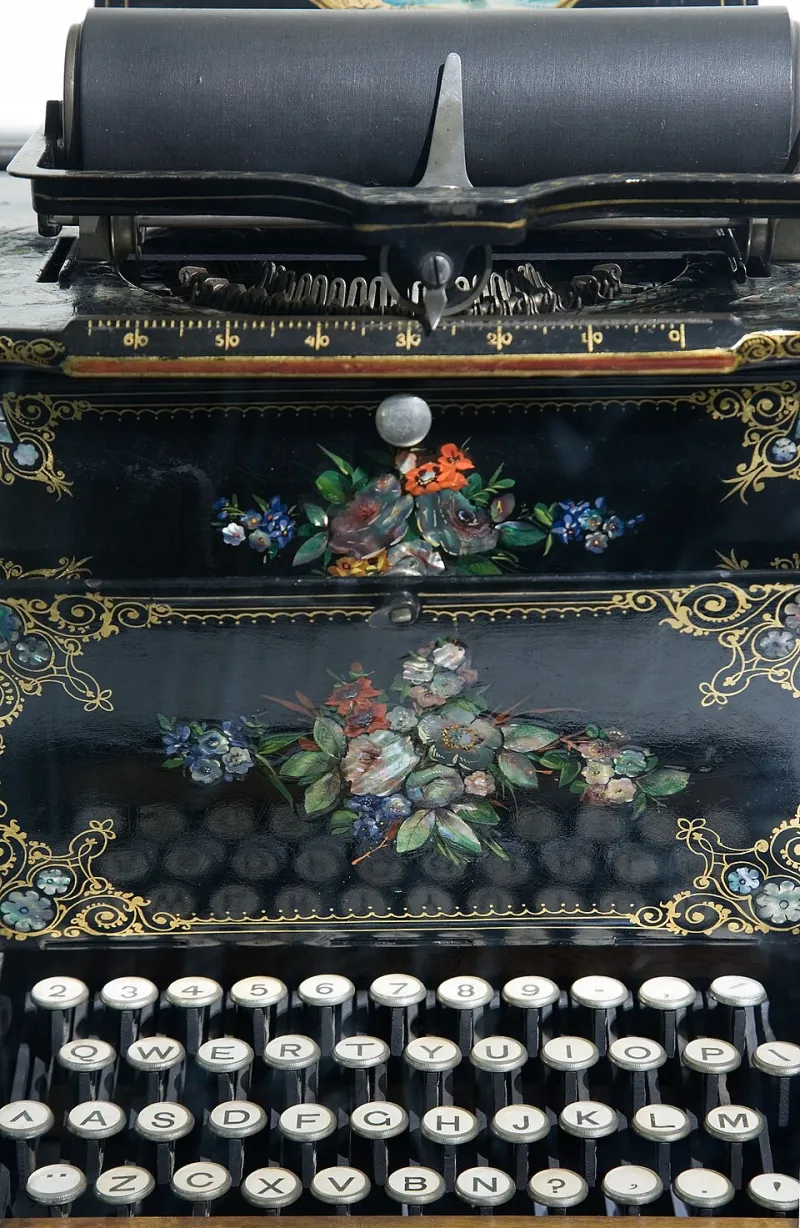
Photo: Jorge Royan, CC BY-SA 3.0, via Wikimedia Commons
A Problem That No Longer Exists
Open your phone. Look at the keyboard on screen. There are no mechanical parts beneath those letters. No hammers that could jam, no type bars that might collide, no physical constraints of any kind. It is a flat piece of glass rendering an image. And yet the letters are arranged in almost exactly the same order they were on a mechanical typewriter built in 1873.
QWERTY is one of the most successful design legacies in technological history — not because it's optimal, but because it arrived early, spread fast, and eventually became too embedded to dislodge. The story of how that happened is messier and more interesting than the explanation most people have heard.
The Standard Version (And Why It's Incomplete)
Ask most people why QWERTY exists and they'll tell you it was designed to slow typists down — specifically to prevent the mechanical type bars on early typewriters from jamming when struck in quick succession. It's a clean, satisfying explanation. It also doesn't quite hold up under scrutiny.
The original Sholes & Glidden typewriter, introduced commercially in 1874, did have real mechanical limitations. Christopher Latham Sholes, the Wisconsin printer and politician who developed it, went through dozens of keyboard configurations over several years of tinkering. Early versions had alphabetical layouts. They caused problems. The arrangement shifted. But the idea that QWERTY was a deliberate mechanical slowdown — a speed limiter — has been challenged repeatedly by historians and keyboard researchers who point out that the layout actually places many common letter combinations in positions that allow relatively fast typing.
The real story is more complicated, and it involves two groups of people most keyboard histories forget to mention: telegraph operators and competitive typists.
The Telegraph Operators' Influence
In the 1870s, one of the primary use cases for the early typewriter wasn't the office secretary — it was the telegraph industry. Operators were transcribing Morse code messages, and the early typewriter manufacturers actively marketed to this market. Telegraph operators had specific needs: they were already trained in a particular rhythm of input, they worked at speed, and they needed certain letter combinations to be accessible quickly.
Sholes reportedly consulted with telegraph operators during his later design iterations, and their feedback influenced which characters ended up where. This is part of why some frequently used letters in Morse code — like the letter E — ended up in relatively accessible positions on the QWERTY layout. The keyboard wasn't purely designed around typewriter mechanics. It was also shaped by the people who were going to use it professionally.
The Competition That Locked Everything In
If the telegraph operators helped shape the layout, it was a typing competition that cemented it.
In 1888, a Cincinnati court reporter named Frank McGurrin entered a public typing contest and did something no one else in the room was doing: he typed without looking at the keys. McGurrin had memorized the QWERTY layout entirely and developed what we'd now recognize as touch typing. He beat his competitor decisively.
The demonstration was widely covered and had an outsized effect on how the typewriter industry thought about training and standardization. Remington, which had acquired the Sholes design and was the dominant typewriter manufacturer of the era, began publishing QWERTY-based typing instruction manuals. Business schools and secretarial programs adopted the layout as the training standard. By the early 1900s, an entire generation of professional typists had been trained on QWERTY, which meant employers expected QWERTY, which meant manufacturers kept producing QWERTY, which meant the next generation trained on QWERTY.
The loop closed fast.
The Better Alternative That Arrived Too Late
In 1936, a University of Washington professor named August Dvorak patented an alternative keyboard layout designed using actual data about letter frequency in English. He placed the most common letters on the home row — the row where your fingers rest — and arranged the layout to minimize finger travel and reduce fatigue. Studies conducted over the following decades suggested Dvorak typists could be trained faster and sustain higher speeds with less strain.
The U.S. Navy conducted one of the more rigorous trials during World War II, retraining a group of typists on the Dvorak layout. Results were positive. And then essentially nothing happened. The war ended, the study was filed away, and QWERTY remained.
The reason is almost brutally simple: switching costs. Every typist in America had been trained on QWERTY. Every typewriter was built for QWERTY. Every business that employed typists had QWERTY equipment. The efficiency gains from Dvorak, even if real, couldn't overcome the sheer inertia of a system that had already captured an entire industry.
From Typewriter to Touchscreen, Unchanged
When personal computers arrived in the late 1970s and early 1980s, there was a brief window when the keyboard layout question could have been reopened. The mechanical constraints that had arguably influenced QWERTY in the first place were gone. Early computer keyboards were electronic. There was no engineering reason to replicate the 1873 arrangement.
But by then, QWERTY wasn't a typewriter standard anymore. It was a human skill. Millions of people had trained their muscle memory to a specific finger map. Retraining them would have required convincing individuals, companies, and educational institutions to absorb a real short-term cost for a long-term benefit that was hard to quantify. Nobody wanted to make that argument.
Today, your smartphone keyboard — a device that couldn't be more different from a 19th-century mechanical typewriter — defaults to QWERTY. Voice-to-text exists. Swipe typing exists. Gesture-based input exists. And still, when most Americans tap out a message, they tap it in the arrangement that a Wisconsin printer landed on after years of trial and error, later refined by telegraph operators and locked in by a court reporter in Cincinnati who won a typing race.
That's not a design story. That's a habit story. And habits, it turns out, are far harder to upgrade than technology.