The Traffic Nightmare That Quietly Redesigned Every American Downtown
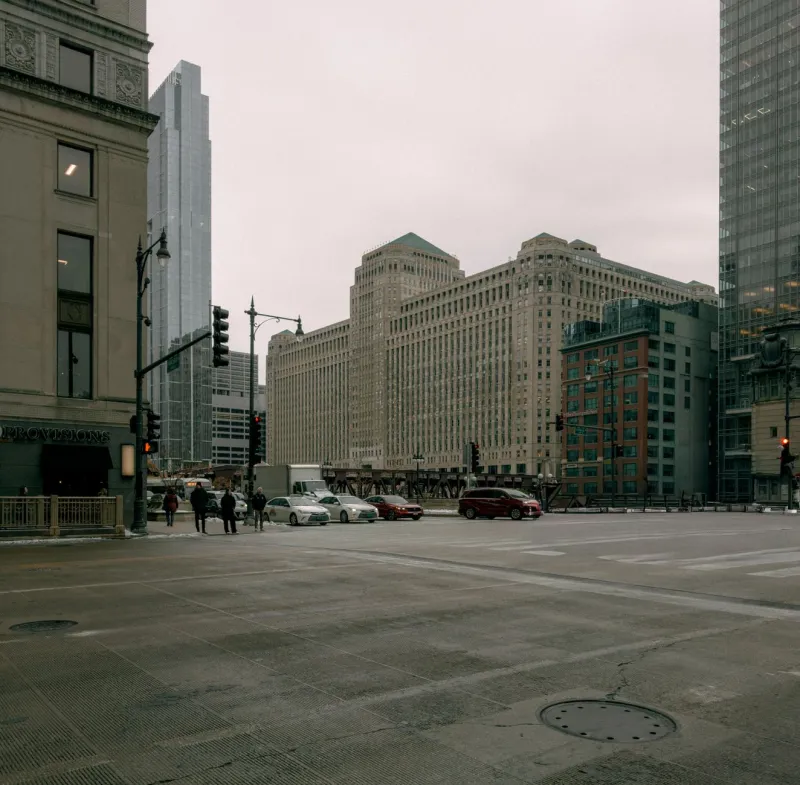
Next time you're waiting at a crosswalk, look around. There's a corner store on one side, a coffee shop on another, maybe a bank or a pharmacy. The sidewalk is a certain width. The intersection is a certain shape. The whole thing feels completely natural — like cities just grew this way on their own.
They didn't. The American street corner, in its familiar form, is largely the product of one of the ugliest infrastructure crises in urban history: the moment when American cities simply couldn't figure out how to move people anymore.
When Cities Started Choking
In the years between roughly 1900 and 1920, American downtowns were in genuine chaos. Horse-drawn carts were still common. Electric streetcars ran fixed routes down the middle of major avenues. Bicycles threaded through everything. And then came the automobile — not yet ubiquitous, but increasingly present, and moving at speeds that the existing street layout was never designed to handle.
The result was gridlock unlike anything urban planners had encountered before. Intersections were the worst of it. Without any standardized system for managing who moved when, corners became negotiation zones where every vehicle and every pedestrian was essentially improvising. Accidents were frequent. Commerce slowed down because deliveries couldn't get through. Pedestrians stuck to the middle of blocks whenever they could, avoiding corners that felt genuinely dangerous.
City governments across the country started commissioning studies, hiring engineers, and debating solutions. Most of the proposals focused on the obvious fix: better traffic management. Signals, officers, rules of the road. Those things came, eventually. But one of the more lasting solutions came from a completely different direction — and it almost didn't happen at all.
The Blueprint Nobody Wanted
In the early 1910s, a civil engineer working on municipal infrastructure projects in the Midwest — accounts vary on exactly where — submitted a proposal that took a different approach to the corner problem. Rather than simply managing the flow of traffic at intersections, he suggested redesigning the physical relationship between buildings, sidewalks, and street corners themselves.
His core idea was deceptively simple: set commercial buildings back slightly from the corner, create a small dedicated pedestrian apron at each intersection, and standardize the width of sidewalks relative to the width of the street. The geometry would naturally encourage pedestrians to gather at corners rather than mid-block, which would in turn make it easier to manage traffic flow because you'd know where people were going to be.
The proposal was rejected. The city in question had already committed to a traffic signal system, and the engineering board considered the corner-setback idea an unnecessary expense. The blueprint went into a drawer.
But it didn't stay there. A copy made its way into the hands of a federal infrastructure committee that was, around 1915 to 1920, beginning to think seriously about standardizing urban street design across American cities. The committee was working on what would eventually become early zoning codes and municipal planning guidelines — documents that would shape city development for decades.
How a Rejected Idea Became the Default Template
The committee didn't adopt the engineer's proposal wholesale. But several of its core principles — the relationship between sidewalk width and street width, the treatment of corners as pedestrian gathering points, the setback logic for commercial buildings — filtered into the planning guidelines that cities across the country began adopting through the 1920s and 1930s.
Those guidelines, in turn, shaped the zoning codes that told developers how to build. And zoning codes, once written, are remarkably sticky. A city that adopted a particular corner-treatment standard in 1925 would see that standard reproduced in every new commercial block built for the next several decades. When suburbs began expanding rapidly after World War II, planners largely borrowed from the urban templates they already knew, carrying the same basic geometry out into entirely new landscapes.
The result is something you can observe today in almost any American town: a remarkable consistency in the way corners work. The placement of storefronts. The width of the apron where the sidewalk meets the street. The way crosswalk signals are positioned relative to the curb. None of it feels designed because it's everywhere — but it was absolutely designed, shaped by a chain of decisions that traces back to a crisis nobody fully solved and a blueprint nobody officially approved.
The Corner Store Isn't an Accident
There's a reason corner locations are premium real estate in American commercial districts. It's not just visibility, though that's part of it. It's that the physical design of American streets was quietly optimized, over decades, to funnel foot traffic toward corners. The pedestrian apron, the signal placement, the sight lines — all of it makes corners the natural pause point in urban movement.
The businesses that ended up on those corners — pharmacies, coffee shops, convenience stores, banks — didn't choose those spots randomly. They followed the foot traffic, which followed the design, which followed a rejected blueprint from an engineer who was just trying to keep people from getting run over.
That's how cities actually get made. Not through grand visions, but through small technical decisions that compound quietly over generations until the whole thing feels inevitable. The American street corner is a perfect example: utterly familiar, almost invisible, and built on a foundation most people have never thought to question.