When Running Out of Paper Made Americans Fall in Love With Books

Photo: Mildeep, CC BY-SA 4.0, via Wikimedia Commons
There's a paperback on roughly every nightstand in America. At airports, in drugstores, stacked on the folding tables of weekend flea markets — the small, cheap, slightly bendy book is so ordinary that it barely registers as an object anymore. It's just a book. But the mass-market paperback is younger than television, and it exists almost entirely because World War Two created a paper shortage that forced American publishers into a decision they never would have made on their own.
 Photo: World War Two, via cdn1.epicgames.com
The comfortable, democratic, grab-it-off-a-spinner-rack book you read on your lunch break is a product of rationing, desperation, and a government program that had nothing to do with literature.
Books Were a Class Object
To understand what the paperback changed, you have to understand what the American book industry looked like before it. Through the late 19th and early 20th centuries, books were expensive, hardcover, and sold almost exclusively through dedicated bookstores. That distribution model wasn't accidental — it was a deliberate expression of what books were understood to be: objects of culture, education, and social aspiration, appropriate for people who had the money, the shelf space, and the leisure time to engage with them seriously.
Publishing houses operated accordingly. They printed relatively small runs of hardcover editions, priced them high enough to be profitable on modest sales, and sold them to an audience that was largely urban, largely educated, and largely comfortable. A new novel in 1935 might cost two dollars — roughly equivalent to thirty dollars today — at a time when a significant portion of the American workforce earned less than a thousand dollars a year.
Reading for pleasure was something middle-class and wealthy Americans did. Working-class Americans weren't the target market, and the entire infrastructure of the book industry — the stores, the prices, the physical format — reflected that assumption.
The War Changed the Math
When the United States entered World War Two in December 1941, the federal government moved quickly to control the allocation of essential materials. Paper was on the list. Publishers faced strict limits on how much paper they could use, which created an immediate problem: you can't run a publishing house without paper, but you also can't just print fewer books, because your business depends on selling them.
The solution that emerged from this constraint was the Armed Services Edition program, launched in 1943 through a collaboration between the government and the publishing industry. The program produced small, lightweight, paperback editions of popular books specifically for distribution to American soldiers overseas. By the end of the war, the program had printed over 120 million copies of more than 1,300 titles.
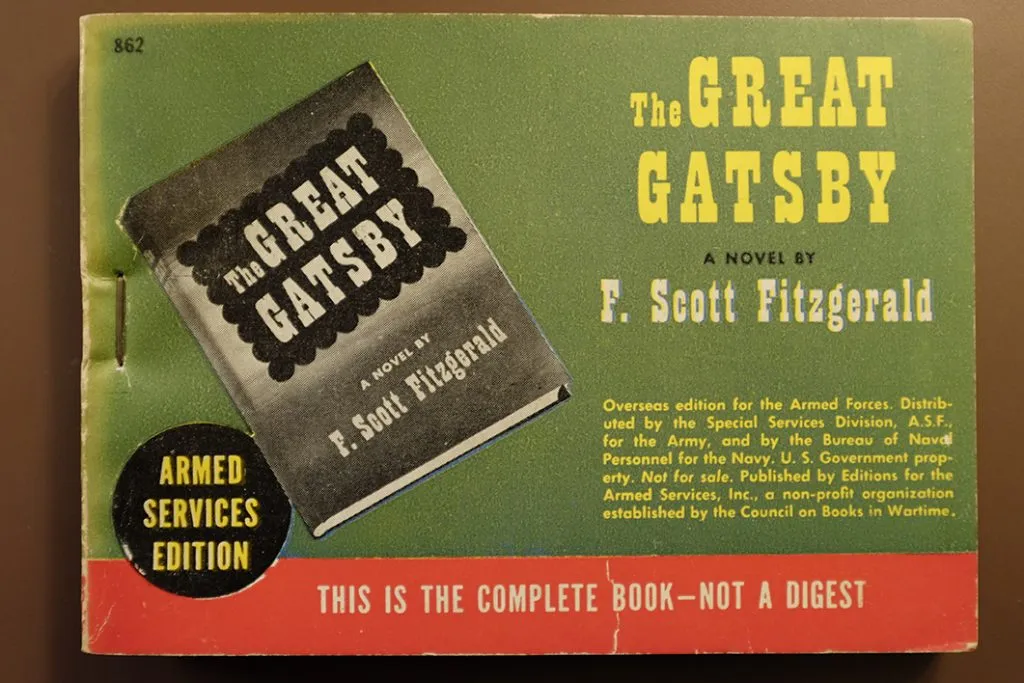 Photo: Armed Services Edition, via blogs.loc.gov
These weren't premium objects. They were printed on whatever paper was available, in a horizontal format small enough to fit in a uniform pocket, with no pretense of permanence or collectibility. They were reading material in the most basic sense — words on paper, designed to be read and discarded. And soldiers read them voraciously.
The Drugstore Revolution
Back on the home front, publishers facing the same paper restrictions made a parallel discovery. If you printed smaller, thinner books on cheaper paper, you could produce more units from your allocated paper supply. And if you were printing cheaper units, you could price them lower. And if you priced them lower, you could sell them somewhere other than bookstores.
The newsstands, drugstores, and five-and-dime shops that already distributed magazines and newspapers had the infrastructure to move high volumes of low-cost printed goods. They had foot traffic from people who weren't necessarily book buyers — people who stopped in for aspirin or a pack of gum and walked past a spinning wire rack of twenty-five-cent paperbacks on their way to the register.
Publishers like Pocket Books, which had actually launched a paperback line in 1939 but struggled to gain traction in a hardcover-dominated market, suddenly found that wartime conditions had created exactly the distribution network and price point their format required. The paper shortage hadn't killed publishing. It had accidentally opened publishing to an entirely new audience.
 Photo: Pocket Books, via images.pixeden.com
What the Soldiers Brought Home
The cultural impact of the Armed Services Editions is hard to overstate. A generation of American men who might never have bought a hardcover book in their lives spent years reading paperbacks in foxholes, on transport ships, and in barracks. They came home in 1945 with reading habits they hadn't had before the war.
The returning veteran market for paperback books was enormous, and publishers knew it. The mass-market paperback expanded rapidly in the postwar years, with genre fiction — mysteries, westerns, science fiction, romance — leading the way. These weren't the serious literary novels that hardcover publishers had traditionally prioritized. They were the books that people actually wanted to read on their lunch break or during a commute, and the paperback format made that kind of casual, opportunistic reading possible in a way that a two-dollar hardcover never had.
By the 1950s, the spinner rack was a fixture of American commercial life. Books had escaped the bookstore.
The Format That Stuck
The mass-market paperback never went away. It absorbed the rise of the airport bookstore, the big-box retailer, and eventually adapted to the online marketplace. When e-books arrived in the late 2000s and early 2010s, many observers predicted the end of the physical paperback — and instead, paperback sales remained stubbornly robust, because the format had trained generations of Americans to think of reading as something you did casually, cheaply, and without ceremony.
That expectation — that a book should be affordable, portable, and accessible without a special trip to a specialty store — is the direct legacy of a wartime paper shortage that nobody planned and nobody would have chosen.
The government ran out of paper. Publishers improvised. And Americans, almost by accident, became a nation of readers.