The Little Pink Nub That Wasn't Supposed to Exist
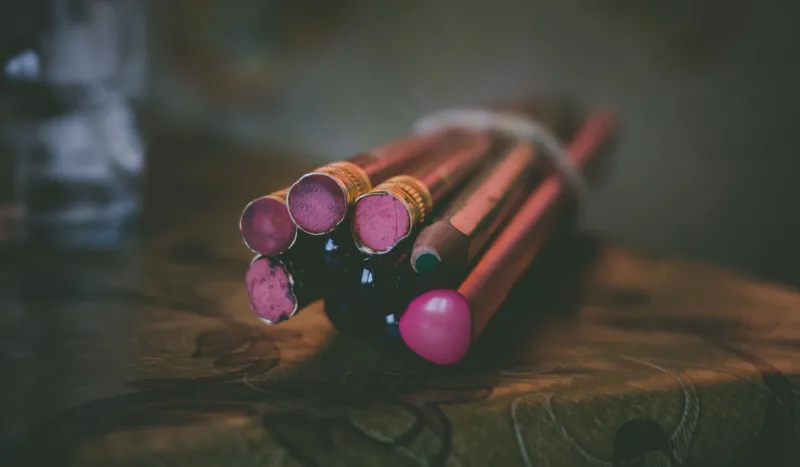
Every backpack in America has at least one. It sits on the end of a pencil, gets chewed on during tests, and leaves those satisfying little gray curls across notebook paper. The rubber eraser is so ordinary that nobody thinks twice about it. But for most of human history, making a mistake with a pencil was a much messier problem to solve—and the fix that eventually replaced it came from an entirely unexpected place.
Before Rubber, There Was Bread
When graphite pencils became widespread in Europe during the 1500s, nobody had figured out a clean way to remove the marks they left behind. The working solution—if you can call it that—was a rolled-up piece of white bread. Not a metaphor. Actual bread. Writers, artists, and draftsmen would tear off a soft chunk of crustless loaf, press it firmly against the page, and drag it across their mistakes. It worked reasonably well, absorbed the graphite, and was conveniently edible when the writing session was over.
For about two hundred years, this was simply how things were done. Then, in the mid-1700s, a strange imported material started arriving in Europe from South America, and everything changed.
The Stuff From the Amazon
Natural rubber—harvested from the Hevea brasiliensis tree—had been used by Indigenous peoples of the Amazon for centuries. They waterproofed clothing with it, made balls from it, and shaped it into containers. When European explorers brought samples back, scientists were fascinated but largely baffled about what to do with the material commercially. It was sticky, it smelled odd in warm weather, and it went brittle in the cold.
In 1770, a British engineer named Edward Nairne was experimenting with a small piece of natural rubber when he reportedly made an accidental discovery: the material removed pencil marks from paper far more cleanly than bread ever had. Whether he was reaching for the wrong thing on his desk or simply testing the material's properties out of curiosity, the result was the same. Rubber gripped graphite particles and lifted them away from the page with almost no effort.
Nairne began selling small cubes of natural rubber as erasers—he called them "rubber" simply because they rubbed things away—and the name stuck permanently. At the time, these little blocks weren't cheap. Natural rubber was an imported luxury, and a single eraser cube cost the equivalent of several dollars in today's money. Careful writers treated them like small valuables.
Why It Almost Disappeared
Natural rubber had a serious problem. In cold weather it cracked and crumbled. In hot weather it turned soft and sticky and smeared graphite instead of removing it. An eraser left on a windowsill in summer might be a useless gooey blob by afternoon. The material that had seemed so promising was, in practical terms, deeply unreliable.
For decades, the rubber eraser remained a novelty rather than a standard tool. The bread method persisted in many parts of Europe well into the early 1800s, not because people preferred it, but because rubber simply couldn't be trusted.
The breakthrough came in 1839, when an American inventor named Charles Goodyear—yes, the tire guy—discovered vulcanization almost entirely by accident. After years of failed experiments trying to stabilize rubber, Goodyear allegedly dropped a mixture of rubber and sulfur onto a hot stove and noticed that instead of melting into a mess, it cured into a firm, stable, temperature-resistant material. Vulcanized rubber didn't go brittle in winter or soft in summer. It held its shape, maintained its texture, and erased graphite just as cleanly as the natural version without any of the drama.
The Pencil Gets Its Partner
With vulcanized rubber now available and manufacturable at scale, erasers became genuinely practical. But they still lived separately from pencils—loose blocks sitting in desks and pencil cases—until 1858, when a Philadelphia man named Hymen Lipman had a simple but commercially brilliant idea. He filed a patent for a pencil with a small piece of rubber cemented into a groove at one end, capped with a metal ferrule to hold it in place.
The pencil with an attached eraser became an immediate success in the United States. American manufacturers embraced it enthusiastically, and by the late 1800s, the eraser-tipped pencil was standard issue in American schools and offices. Interestingly, the design never caught on to the same degree in Europe, where pencils and erasers remained separate tools—a cultural split that persists to this day.
What's Actually Inside Your Eraser
Here's the part that surprises most people: the pink eraser you grew up using—the rectangular kind, the kind shaped like a little brick—isn't actually made from natural rubber anymore. By the mid-20th century, manufacturers had switched to synthetic rubber and vinyl compounds, which were cheaper to produce and performed more consistently. The pink color? That was a marketing decision made by a manufacturer who wanted to differentiate their product. It had no functional purpose. It just looked distinctive on a school supply shelf, and the color stuck so thoroughly that "pink eraser" became the default mental image for the entire category.
The white erasers that started appearing in the 1990s—often marketed as "artist's erasers" or "soft erasers"—are typically made from vinyl and are actually gentler on paper than the classic pink variety. But the pink version endures, sitting on the end of pencils in classrooms across the country, doing the same job it's been doing since a distracted engineer in 18th-century London grabbed the wrong thing off his desk.
The Accidental Tool That Became Essential
There's something quietly satisfying about the eraser's origin story. It didn't emerge from a deliberate research effort or a commissioned invention. It came from curiosity, accident, and a practical problem that bread had been solving badly for two centuries. The rubber eraser is proof that the best solutions don't always come from asking the right questions—sometimes they come from reaching for the wrong thing at exactly the right moment.